OI
Projects and Purposes
The Odradek Institute, in the first instance, has for
its agenda seven principal fronts for action:
1. A Language for the Representation of Musical Ideas
A great deal of work towards this object has already been
completed; critiques, however, will be greatly appreciated. The language,
Rusty,
has been extensively planned and coding has begun, albeit with very limited
resources. Progress on the coding will be reported on this
page.
What is needed: good Java
programmers, a big computer, meta-theorical critics.
2. A Catalog of Musical Structures and Processes
We seek to assemble a library, or, perhaps more accurately,
a museum, an Alexandria of musical ideas collected from all regions of
the world and from all historical eras. Eventually, for utility and
easy comparison, they will all be represented in the Rusty language.
For now, a listing of resources will be assembled and contributions of
online resources encouraged.
What is needed: interested
ethnomusicologists, musicologists and music theorists who love clarity.
3. Comparative Musicology
This is the work of compiling the above
catalog and comparing its contents---comparing objects of a similar type
from different music theories (e.g., African and Eastern European rhythms,
raga
and
maqam)
or comparing how objects of different types are used together in one theory
(e.g., how the tuning of Chinese scales suits Chinese orchestration or
how Western art music rhythms are used with its harmonic system) or how
they might be mixed (e.g., how Indonesian layered polyphony might be used
with Western harmony or how Turkish modes might be used with
tala
or counterpoint).
What is needed: interested
parties, as above.
4. Combinative Composition
We would like to foster an ethos of composition which combines
the structures and techniques of different music theories, as suggested
above. As Rusty is coded and as the catalog of structures
and processes grows, it will become increasingly easy to compose and realize
pieces automatically, using computers.
What is needed: enthusiastic
composers, software (Rusty generators, the catalog, performance
and synthesis tools).
5. Speculative Music History
Consider a binary discipline: precise, conservative and strictly
qualified studies of historical structures and processes on the one hand
and, on the other, wildly speculative composition constrained only by the
limits of the scholarship. This might lead to styles of music analogous
to the linguistic reconstructions of ancient languages, extrapolating backward
from what is known into what might have been---and what might have been
otherwise.
What is needed: enthusiastic
parties and software, as above.
6. Performance Studies
A scientific study of performance details should result in
computer models suitable and sufficient for automatic reconstruction of
style and expression. This will take a great deal of analysis of performance
details in the context of the music being played in order to posit rules
for performance and, eventually, to discover the form of all performance
rules, so that performance can be parameterized.
What is needed: interested
researchers, willing performers, software.
7. A Catalog of Software Instruments
The Csound computer
language is perhaps the ideal vehicle for performance of music and the
synthesis and processing of sound. As a practical aid to researchers and
composers, a catalog of standard instruments (mostly imitative of acoustical
instruments and studio equipment) would be of great use. Some acoustical
data, particularly formant data will be useful in this effort. Some
progress on this front has been made, and contributions will posted here.
What is needed: Csound
programmers, time, data.
-
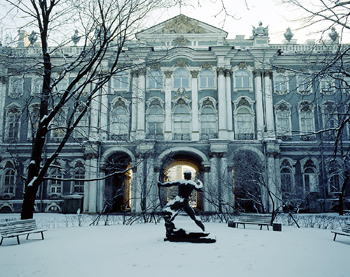
The laboratories and workshops, housed behind the main building.